Jackie Davies
Jackie Davies

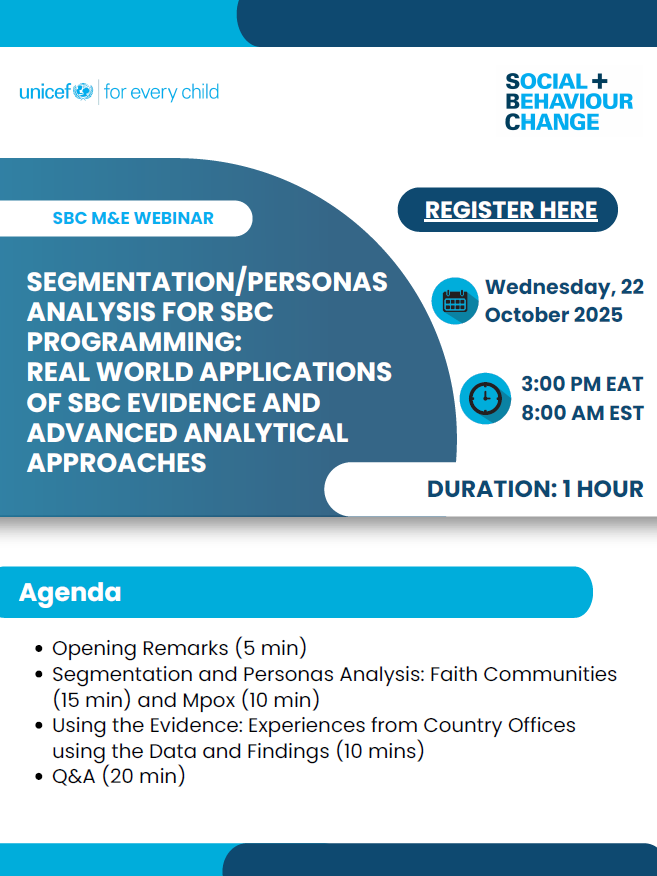
Event: UNICEF SBC Webinar 22nd Oct: Segmentation/Personas Analysis for SBC Programming

UNICEF would like to extend the invitation to the upcoming Global Webinar on Segmentation/Personas Analysis for SBC Programming: Real World Applications of SBC Evidence and Advanced Analytical Approaches.

October 22 @ 1:00 pm – 2:00 pm

This webinar offers practitioners, partners, and colleagues in SBC, M&E, and programme implementation an opportunity to deepen their understanding of segmentation and personas analysis, explore UNICEF’s practical experiences, and strengthen alignment on shared measurement approaches.

The session will: Introduce the concept and value of data segmentation and personas analysis, and spotlight findings from Faith Communities and the Mpox Community Rapid Assessments (CRAs), both offering unique and nuanced perspectives on communities through data segmentation, and showcase evidence in action: Country Office experiences applying data and findings to strengthen programmes.

For more information and to book click here. 

News: SBC Voices – Prospects, Opportunities, and Challenges for the SBC Sector

Report: Prospects, Opportunities, and Challenges for the Social and Behaviour (SBC) Sector – What SBC Professionals Around the Globe Have to Say, October 2025

This report presents the responses of a wide range of participants of the Global Alliance webinar on the SBC current context. It presents submitted responses and summaries.

Summary of Responses

  • Looking ahead, what emerging trends or challenges in your field will require new approaches to social and behavior change? The SBC sector needs to lead in integrating responses to these global trends in an innovative way. Their rise brings challenges that demand adaptive, community-driven SBC approaches more than ever before. These must be rooted in trust, inclusivity, and locally-led innovation, especially among youth and marginalized groups.
  • What does the SBC sector and community need to grow and strengthen?  There is a clear desire for simpler, more accessible language and stronger advocacy to communicate the value of SBC. Participants argue that SBC must be easy to understand for policymakers, funders, and other sectors, articulating clearly how it drives social transformation and long-term outcomes. The call is for a unified narrative, practical messaging, and visible champions who can position SBC as indispensable to achieving the SDGs and national development goals. Greater visibility and strategic storytelling are essential to building  recognition and influence.
  • Where do you see the greatest opportunities for cross-regional or cross-sectoral learning and collaboration? No longer optional, cross-regional and cross-sectoral cooperation is essential for impact.  Participants see opportunities with movement building and supporting wider youth development by mobilising resources for cross-sectoral growth. There’s hope for digital health campaigns, climate resilience efforts, and youth-led cross-regional activities. These subjects naturally bring voices together across borders and sectors. This can be advanced through clustered engagements that enhance mobilisation and advocacy, while investing in capacity building and creating cross-learning spaces across countries to share lessons and best practices.
  • How can we effectively elevate our SBC voices and presence? Participants emphasize that strengthening SBC’s visibility and legitimacy requires unity, evidence, strategy, and inclusion. A unified and strategic voice is seen as essential to align efforts, assert SBC’s legitimacy, and advocate collectively for influence and recognition. Visibility should be fuelled by “emotion backed by evidence,” using data-driven storytelling, digital media, and organized knowledge platforms to connect with diverse audiences and showcase impact. Finally, participants stress the need for SBC to enter policy spaces, form cross-sector partnerships, and elevate local and diverse leadership so that advocacy reflects authenticity, shared power, and global credibility.

Background on the Report
In September 2025, the Alliance hosted two sessions of an online event titled Current & Continued Importance of SBC: Strategic Directions & Future Goals, attended by 175 participants from around the globe. As part of the webinar participants were asked to respond to the 4 questions above. All participant responses were coded and categorized. Summative statements for the most frequently mentioned themes and suggestions are presented in this report.

The Alliance wishes to thank all participants and Alliance members who contributed to the event and this report.

Report Authors:  Stephanie Tholand and Joel Mercado

Read the Full Report here. 


News: Call for New Members

The Global Alliance for Social and Behaviour Change’s 2025 Call for New Members is now open!

We invite organizations and individuals active in the SBC sector to join the Alliance.

The deadline for submitting your Expression of Interest is Friday, 14 November 2025.

For more information and to access the EOI form, visit https://globalallianceforsbc.org/membership/.

The review process will be completed by December 1, 2025, and new member terms will begin January 1, 2026.


Resources: ‘ABC of SBC’ – A Podcast Series (UNICEF)

‘ABC of SBC’ – A Podcast Series from UNICEF

UNICEF are producing an engaging series of podcasts that focus on social and behaviour change.

This podcast series, produced by UNICEF, explores the role of Social and Behaviour Change (SBC) in advancing child rights and addressing complex global challenges. Through interviews with practitioners and experts from diverse regions and disciplines, the series examines how SBC strategies can contribute to progress in areas such as gender equality, climate action, health, and education. It aims to demystify SBC and present its practical applications in an accessible format.

Across two seasons and fifteen episodes, the series has covered a wide range of thematic areas. Recent episodes include discussions on SBC in faith engagement to end harmful practices, community system strengthening in conflict-affected and marginalized settings, and online child protection in the face of evolving digital threats. Other episodes focus on SBC’s contributions to immunisation, mental health, planetary crisis response, and violence prevention. Each episode highlights real-world experiences, ethical considerations, and the potential of SBC to influence positive social norms and behaviours.

The podcast is designed to be informative and reflective, offering insights into both the possibilities and limitations of SBC in development and humanitarian contexts. It is available on major platforms including Apple Podcasts, Spotify, and Amazon Music.

Link to the Podcast Main Page

Resources: SBC Guidance Website (UNICEF)

This resource website offers a wide range of guidance for social and behaviour change practice.

This is a resource developed and maintained by UNICEF to support Social and Behaviour Change (SBC) practitioners working across development and humanitarian contexts. It was created to strengthen the quality, consistency, and impact of SBC programming globally, offering a structured, evidence-based approach rooted in UNICEF’s experience and commitment to equity, participation, and inclusion.

The site provides step-by-step guidance across the full SBC programme cycle—from formative research and strategy design to implementation, community engagement, and monitoring and evaluation. It includes downloadable tools, templates, case studies, and links to global standards, all designed to be adaptable across sectors such as health, education, climate action, and child protection. The content is modular and user-friendly, allowing practitioners to access relevant materials based on their role, context, or stage of work.

Regularly updated and designed to evolve with the field, the SBC Guidance site is a trusted reference point for practitioners seeking to build effective, inclusive, and context-specific SBC initiatives. It also serves as a platform for learning and collaboration, encouraging users to share insights and adaptations to strengthen SBC practice worldwide.

Link to the SBC Resource Site


Resources: Menu of SBC Results and Indicators (UNICEF)

UNICEF have developed a menu of SBC indicators that is a resource for the sector.

In this resource the SBC indicators are presented in a dashboard.

They are a compilation of existing indicators and results that UNICEF uses across multiple programming areas and approaches.

This list has been vetted and compiled by UNICEF’s Social and Behaviour Change (SBC) team, in collaboration with the organization’s sectors and cross-sectoral teams.

It includes outcome measures and indicators that already exist and are currently used in field research, evaluations, local strategies, data collection surveys, and more.

Each indicator includes a reference to its source, along with detailed information on its use and implementation. Indicators may also be adapted by incorporating relevant questions into broader data collection efforts, beyond the original source. The indicators and dashboard are based on UNICEF’s Behavioural Drivers Model and the Socio-Ecological Model.)

Link to the SBC Menu of Indicators


Resources: Repository of SBC Capacity Resources (UNICEF & Global Alliance)

The repository of SBC capacity development resources is a user-friendly, living dashboard that brings together a curated collection of freely available resources for SBC capacity development.

This collection of information about available courses has been initiated and managed by UNICEF SBC.

Members of the Global Alliance for SBC, and all interested SBC experts, are invited to contribute to this resource by suggesting additional resources. To do so please send suggestions to info@globalallianceforsbc.org.

Link to the Repository


News: SBCC Summit – Abstracts Deadline Extended to 14th Nov 2025

The SBCC Summit organisers have announced that they are extending the deadline for SBC practitioners to submit abstract to the 2026 International Social and Behavior Change Communication (SBCC) Summit.

The final deadline for abstracts is 14th November.

SBCC Summit organizers note: ‘To all practitioners, researchers, advocates, and storytellers, please submit your work through the lens of the 2026 Summit theme: The Power of Connection: Reimagining Knowledge, Action, and Equity in a Changing SBCC Landscape.’

SBCC Summit – Abstracts Extension


News: WHO SBC Indicators Survey – Extension for Feedback to 15th October, 2025

WHO is calling for inputs to indicators for the mainstreaming of behavioural sciences into public health.

The deadline for feedback was 8th Oct (and the survey will continue to show this date) however the deadline for inputs has officially been extended to the 15th October.

Global Alliance members and other SBC practitioners are encourage to add insights to this inquiry.

Link to the SBC Indicators Survey